Chapter 23: The Homeless and The Garage
I assume, frankly, if you work this job for any amount of time, you’re going to have relations at least to some extent with the local homeless. Where I work at present, strangely, has little to no vagrants wandering around, though this is a rare exception.
Because half or more of your job occurs in a parking garage, and for some of you it occurs at a hotel, homeless wanderers are almost sure to be a part of your work habitat. Exceptions like mine, are when locations are not a walkable area—and these are rare because the hospitality business desires walkable locales.
Firstly, as a valet, you are not qualified to subdue the crises these people may suffer day to day. Call emergency services for any contact that goes beyond kindly asking them to leave the premises, if they are trespassing. I’ve had this experience countless times, not without empathy. A memory that melts my soul every time is when, at around 6am, one of the Engineers of my hotel told me to kick out the homeless duo sleeping in the garage, so I walked to the bottom of the parking ramp and there they were. Couldn’t have been older than 25, a man and woman. As I approached, I could see their hair moving, full of lice. They lay underneath one of our vents where hot air was expelled, and I had to stand there for a moment, dumbly, deciding how to wake them up. What word do I use? So I raised my voice and hollered “Hey!” There was no argument or protest. They sadly walked the ramp to the exit, off into the cold morning.
Pretty straightforward. As far as practical advice, that’s the basic story for you: your employer will very often lean on you to take care of these interactions. Being a garage monitor is not exactly in your job duties, at least not the level of handling potential danger, and certainly, some properties have security staffs specifically for these situations, but often, and especially if you’re at a mid-grade property, the responsibility will be thrown on you. And so I must be repetitive in stating that many, many times in these situations, you need to defer to professional authorities. If you don’t have the local non-emergency police line saved in your phone, get it. If you work in a remarkably progressive city that has a dedicated homeless outreach branch, get that also. Where I work and have spent a great deal of my life, the local police have a habit of homeless dumping—simply picking these people up from one location (the nice parts of town) and dropping them off in other locales (the crummy side).
One time I directed a man to leave the premises. Over the years, I’ve buttoned up a whole lot with my word choice in these scenarios, and I recommend you do too: say “sir/miss, please leave the property.” End sentence. If they attempt arguments for staying, you can say frankly, “no, this is not a negotiation, please leave.”1 Vagrants will also frequently try to negotiate time with you—a recurring bit is someone asking you if they can plug in their phone just for enough time to call an uber. This is almost always a lie. They just want the power. Again, “no” is a full answer. You do not need to come up with some explanation as to why your answer is no. It’s just no.
-
A retelling of the scammer story: one time a man took advantage of hotel staff’s impatience. He had loitered in the lobby several days, stealing breakfast, before being asked to leave. Then on another date, he booked a room in the hotel and appeared in the lobby the following morning. The hotel staff, assuming he was a loiterer again, asked him to leave, using less than professional language. The ensuing turmoil was comical and wicked. The eventual legal battle hinges largely on how hotel staff worded their command to the scammer to leave the premises. Note that I was personally involved in this incident: the man verbally insulted me a lot that morning, I remember having a hard time keeping a straight face when he called me a “leprechaun” and flashed his fancy watch at me to prove his high societal status— unfortunately, these gestures cannot be taken as fun comedy: he clearly hoped to catch me uttering legally abusive insults back at him (which I didn’t).
But about that one time—and the man. I asked him to leave, and he refused to do so. Looking at him, I recognized that he was high. His pupils were like great death saucers—all void. He proceeded to act very strangely in the lobby, at times drifting into Employees Only areas, crouching behind the front desk as if he were hiding. The police were called. One officer arrived and attempted to detain him. The struggle was violent, bloody, and their bodies slammed all over the lobby fixtures. Another officer arrived and began helping. Still, the man put up a strong fight. A third officer arrived. They tasered him. Screams rang out like Satan putting the first burner on a newcomer in the inferno. Still, this man fought tooth and nail. Eventually five officers pinned him to the ground, emptied his pockets, and hauled him away Hannibal Lecter style.
I want to note about this incredibly ugly incident: my coworkers talked the rest of the evening about it, processing the little trauma as witnesses. In one fashion or another, they all wanted to make sense of the outbreak, as it was so unreasonable for this man to behave the way he did. I repeatedly told them he was on drugs. I had seen the meth pipe on the floor when they emptied his pockets. My coworkers, strangely, did not seem to comprehend this piece of evidence the way I did. See, I’ve done meth. I’ve been as confused as that man in my life. I know that where they took him was going to be a terrible nightmare, and one that goes on for weeks, months, years. Before everything broke out, I even tried to warn this man to leave the hotel on the basis of this incoming suffering. But he was too confused.
My colleagues at the hotel were shook up about the scene, understandably. But their imagination for human suffering seemed to run dry at the part where a drugged out vagrant could get so mixed up. The brutality of the event made their empathy stretch further than normal, and it was a rare instance where I could see my coworkers trying to find the midway between “drug addict” and “person.”
Inversely, I’ve had a difficult time explaining to my young co-workers sometimes that when you see a street person yelling strangeness or obscenities to nobody, they are, possibly, not on drugs at all—that the human body is capable of madness without the chemical influence of drugs.
There is one homeless man that I worked around for several years who is an outright philosophical problem. I will propose it to you now, as I did with my fellow workers on many occasions. Bear in mind that this was not a hypothetical situation. I was witnessing it.
Fred was homeless. He lived in the bushes, across from the public parking about 500 feet from the hotel. He was very dirty most of the time because of his sleeping situation, and though a young man, his posture was gravely marked, presumably because of bad sleeping surfaces, and he walked every day past the hotel entrance over to the bridge by the beach, where he would buy dope. How he got the money for dope, I do not know. Occasionally he would get a shower and clean up at the local church. Other than his dirty appearance and general vagrancy, Fred did not bother anybody. Truly a saint of homelessness. He didn’t pick butts out of our cigarette ashtray, he never begged, he didn’t even speak to you unless spoken to. He didn’t urinate or defecate in public, nor did he infringe on private facilities for doing so—he politely used public toilets by the ocean when needed.
Some days Fred looked really bad. His dirtiness was third world, sometimes he got severely sunburned because he would nod out in full UV exposure, and his skin would be so dangerously blistered that he would walk around shirtless to avoid blister infection or irritation.
Now here’s the problem. In my depiction, I have probably even understated his good behavior as a homeless citizen. This guy bothered nobody. The questions can go a couple ways:
Is it ethical to be Fred? To live a life of homelessness and dope so long as you keep to yourself and don’t bother anyone. As I surveyed my coworkers, most of them boldly claim it’s a life choice that he deserves to make.
Is there an imperative for anyone to help Fred? At this question, most of the people I asked think assuredly not. He doesn’t want help, they say. Of course, they haven’t talked to him, so how do they know?
Perhaps these questions are far from the topic of this book, and from wage work as a hotel employee. Though at times, even doing the little work we do, wage employees stumble upon such ideas, and so I share them without fear of inconsistency.
Many valets, when they join my current work location, claim that they left a downtown area specifically because the homeless “problem” was too stressful. It might be a rough time in the history of homelessness, particularly, but in any event I’m quite sure the poor in spirit go back a long way in history. I’m less sure there’s a messiah that will come and fix the problem anytime soon. One can hope, though, and in the meantime, have some grace when you’re parking cars. I disagree with the survey of my colleagues about Fred, and while I don’t enjoy laying an absolute opinion all that often, I’ll close this careful chapter with the stern argument: you’re meant to live a life that contributes to a better cosmos. And I hope for a world that offers me help even when I don’t want it. Once in a while.
Chapter 24: Location
I have worked at 3 valet locations full time, 2 others seasonally, and more than I can remember for single days where I picked up shifts on the fly all across town. More or less, the job is always the same at any valet site: park cars, maybe bellman duties additionally. Sometimes you might be stuck as a “lot attendant” where all you do is issue tickets and tell people where to go. Dreadful.
However, location is the single most important factor to your income. Let’s start talking there. Firstly, if you’re making less than a third of your income in tips, I advise you try to move locations. This is assuming that your hourly wage is low—I can understand if you’ve received good hourly compensation holding up at a slow tip locale. But generally speaking, there are plenty of valet sites where the tip out is in excess of 50% of your hourly wage. My current location is nearly dollar for dollar hourly and tips. Comes out to a total wage of about 35 an hour.
To you younger or prospective valets: do not assume that because a place has a high volume of business or high end clientele that the tips will be good, or can’t be better elsewhere. The formula for high tip shifts is low employee numbers plus steady business. It’s very difficult to discern how this pans out until you begin working at a place—valets, like everyone else in this life, it seems, have a sort of famine mentality so that if you ask them ahead of time what the tips at a location are like, they are apt to lie to you. Some have even refused to tell me before.
It’s a good strategy to get experience at any valet site, any site that will hire you, and then try to move along to a better location. Do not be discouraged about how crazy and difficult it is to land an opportunity at another site. Bosses on these accounts really don’t have much sense about “good” and “bad” employees, and it takes mostly luck to land this kind of job. Referrals, however, are the surest way to make a transfer. Being chummy with your current employees, including the aforementioned and ridiculed management, is the best way to succeed in your quest for a good spot. I once was interviewed for a new position with a valet company, and they were considering hiring some of my previous co-workers as well. I knew the question would come—what do I think of these couple of guys? I gave them only facts, no feelings: I told the interviewer some grievous sins of these particular workers, that one of them had a predilection for damaging vehicles, and that the other was a constant liar and thief. They hired all of us.
Obviously you’ve got to factor in social and personal life with where you work: it’s best if you live near the property for all reasons, such that you’ll never have to lie to hotel/site guests about the area, your commute will be minimal, life will be easier in so many ways. It’s not so bad to commute up to an hour away though, and may be necessary. If you get tired of commuting, just switch again.
Be ruthless in switching locations. It’s one of my greatest errors as a valet, I didn’t realize until six or seven years into it that there’s no penalty in life or career for doing so, not so long as you keep kindly relations with your peers and exit jobs on good terms. Do not quit your job without notice. It might be a miserable notion to some of you, but this particular job field will be delighted to invite you back, again and again, so long as you quit on good terms. I’ve had several periods of unemployment where my old bosses called me up offering me a job. Thing is, I don’t have to accept. It’s nothing but a benefit to be on their roster, even in the off times.
There are some places you assuredly want to steer clear of. I almost feel like proclaiming hospitals are one of them, outright. Often hospital valets are ineligible from tips, and the entire clientele is miserable. The last guy anyone has thought about when approaching an emergency room is a valet. I’ve never done it, and only heard stories from these locations, but man oh man does it sound awful.
You should also probably not accept assignments from a valet employer to work massive, special events. One time I drove all the way to Hollywood for one of these “special shifts,” a red carpet affair with celebrities and all the hoopla. Thing is, companies want to look extra dapper at these huge events, so they send an army of valets big enough to conquer a small country. I made about thirty dollars to stand in a row with a hundred other red-vested goons. It didn’t cover the gas to make the trip, and I didn’t see any celebrities.
On the other hand, there are events that pop up you absolutely want to get your valet hands on. If your local horse-race track has a major season—that’s the kind of location you want to latch onto for however many weeks it lasts. Perhaps too ideal of an example, because gamblers are some of the best tippers, plus horse-racing attracts old and new money, but seasonal work is worth a shot, generally speaking.
I mentioned it in the last chapter, but locations in downtown areas are going to be the most stressful in terms of your driving/parking. Often the tips don’t work out that grand, either. That’s a situation you may want to quit without even having another job lined up: if the tips are bad and the work is intense, that’s just a recipe for bitterness and misery.
One of the only insights you can guess about tip money before you begin a job is assessing the customer base. Not on their style or wealth, but what brings them to the destination. Very plainly, if you have a lot of daily visitors, cars that come and depart within the same day, that will equate to more money. So ask your interviewer how many daily cars they get. If you want to be extra nerdy about it, my formula for the money is this: every car tips about 5 dollars, multiply 5 times the number of cars he says, divide by number of staff members working each shift. That’s it. That’s one shift’s tip out, projected.
This is all, more or less, with money in mind. There is, of course, so much more to consider. Culture. What a strange word. My mind reels between Eustace Tilley and the image of bacteria in a petri dish. There are some obvious culture considerations in valet locations. For instance, Las Vegas is probably the best place in the United States to work in this business (as far as money), but I would never want to live in that city.
Some of you plainly will prefer lower income and a slower job site. I don’t hate that. If you’re a student, a slow valet location can be an ideal place make money and do homework at the same time. Other valet locations are extremely physically intensive. Just a couple days ago I was chatting with my coworkers about the impossibility of gaining weight on our job. In a sad but realistic way, I have in mind a particular valet location near me for “retirement,” a place that gets few but very high end cars in one of the wealthiest neighborhoods in America. I will ask for a transfer there when my body can no longer handle the 10-15 miles a day of running.
It is practically a pillar of Millennial career advice to change jobs frequently, and though I can’t speak to that bigger culture shift in labor, my similar recommendation to switch locales without remorse has definite positives I can articulate with ease. For one thing, on this type of job, experience at many sites is an absolute benefit for the practice of parking cars. You’ll be better at maneuvering through different environments the more you’ve worked in. That’s pretty straightforward. Frankly, your bosses and coworkers will give very little shits about where you’ve worked previously. Many times on a valet driveway I tell a story from one of my previous locations, and no matter how many times I dredge up the past like this, my current coworkers seem to have forgotten I’ve lived a previous life at all. So the benefit of past experience is really just for you, not so much your prospects with a current employer. And that might apply to a lot of parts of life. It’s like Slumdog Millionaire—they’d sooner torture you for knowing a magical bit of trivia than wonder how you’ve actually learned anything in the course of your life. Time and again, when someone walks into an arena as an absolute crusher, the response from others is incredulity.
And what’s happening, culturally, that makes this phenomenon occur again and again, is another thing you can investigate casually about any valet stand. Even at the lowest position—standard valet—you can ask questions about the account your working for. What’s the contract? How is revenue divided between your company and the location (assuming you’re contracted, perhaps you’re employed in-house by the site)? At my current location, through chatter and physically viewing hotel spreadsheets, I know the revenue numbers for both our service, the valet, and the hotel. The short of it is this: we are profiting a lot of money every night. This is not the case for all valet locations. My longest tenure at one spot was an account that barely broke a profit each year. We existed mostly to pay employees and stand as gang like territory in a competitive region for rival valet companies. This is all somewhat laborious and boring to explain, to most workers—I mean, the guys I work with, I’m quite sure, hardly ever think about the larger scheme of their employer’s revenue. But it does matter to you. I have many times been privy to my valet location being in the red for several months, and meanwhile my coworkers bitch about not being issued a hat to wear on the job.
So this example of whether or not your company at large is making money is a fast demonstration of how connected money and culture are. Your boss, your account manager, they’re going to be constantly talking about revenue numbers with their higher ups. It occupies a huge part of their mindset about the job. I bring it up to advise that you remain interested in larger financial pictures than your own—it can help steer your behavior. For those of us that have worked at a business that has completely flopped, we know how fragile the workers at the bottom are. There’s no bonus for us. They’ll schedule you to work the last awful week before termination when, if you were thinking clearly, it’d be smarter just to max out sick time and begin searching for other work.
Do not, however, overestimate the connection between money and culture. Or to be more precise, do not oversimplify the connection. Where I work now, all valet employees make about 30-35 an hour, total wage. At the time of this writing, I consider this a very high wage, and probably one of the highest in our industry and in our region. And yet, with no outstanding pride in saying it, many of my present coworkers are deluded into thinking they’re in a bad spot. They’re very often ungrateful. I hear a lot of complaints about the hotel and its employees. At the end of certain shifts when my coworkers receive their cut in excess of one hundred dollars in tips, they express that it ought to be more. It’s incredible. That said, the cost of living in our area is just about the highest in the whole country. None of us can hope much for old American ideas of owning a home or property on this wage, in this area. It’s possible, but requires the kind of credit dealing that collapsed the economy in 2008. Rent in the immediate area around our hotel is about 3000 a month, and rent in the poor neighborhoods twenty or thirty minutes away only dips to about half that. So there is some apology in the face of their material complaints. However, for a job without educational training, I rate our wages high anywhere in the world, and it’s a good reminder that people are apt to become bitter no matter what the circumstances.1
-
I suspect my annual income is higher than, or equal to, my manager’s. He is on salary, cannot collect tips, and would require a gross income of over seventy thousand dollars to gain a net pay that’s even with mine. It’s possible he’s receiving this, though I doubt it. One of the easier negotiating strategies for a valet company is to promote an eager twenty-something-year-old into a management position, with all the social clout it portends, and rig them up with a contract not much greater than being an hourly guy like me. What leverage does a valet manager have, other than threatening to work for other valet locations? The job is so niche and antiquated, there’s not much he can negotiate, save for opportunities in the hospitality industry at large. Trust I don’t mention this with an absence of pride, though there is just some practical “heads up” in alerting any young readers that management is its own thunderdome. And remember how I mentioned that I’m familiar with valet revenues and hotel revenues? The real money is in the hotel, always. A successful hotel is raking multimillions annually. Valet accounts hardly scratch one million per year, usually much less.
Every location has its own small culture going on as well, of course—its workers and its clientele construct the bulk of how that looks. For a long time I had a clientele that was largely related to the united states military—active duty members or defense contractors, because my location was right next to a military base. I used to whine about their habits a little bit, their personalities and the vehicles they tend to purchase. I’ve spent way too much time in my life dreaming of suicide, but representing an institution that can order you to kill others is a bit too submissive for my preference of murders. It’s funny though. Now I’m working at a location that attracts super bourgeois wax-jobs (car and body), and I find myself sometimes missing the gruff and confused masculinity of those marines, their trucks with mud caked on the outside and drivers inside that couldn’t pronounce the word “bourgeois.” I promise that wherever you work, you’ll develop sometimes ugly and distorted feelings about the general clients. There are times when it gets to be too much, when you’re not crazy for desiring a different location because the clientele overly angers or depresses you. I skew this direction with the rich. One time, a man with a Ferrari asked me to lead him into the garage to retrieve something from his vehicle. When we approached the key vault, he declared to me that he has one just like it in his garage—a box for housing the keys to his multitudinous collection of cars. I could barely keep myself from asking, with malice, “why on earth would you share that with me?” I wonder if Solomon ever called a male-servant into his bedchamber for a jug of water, and the young man walks into the softest room he’s ever seen, concubines and wives loafing around, there’s three in the bed, four more cuddled up on some Old Testament divan, a few more preening in a gold framed looking glass. Solomon, I imagine, like the Ferrari man in the garage, would think it was some kind of hot favor to invite the young man in the room, like “check this out! Aren’t I rich?!”
Another time at my rich location, there was a funeral service, or, “a celebration of life” as they called it. Working about ten years in hotels, I’ve never seen an actual memorial service hosted at one. It’s not uncommon for mourners to come stay at our lodgings and attend the ceremony elsewhere, but to put the ugly numbers on the occasion, hosting a memorial at this hotel requires renting the space for upwards of twenty thousand dollars. The bereaved also “hosted” the parking fees, which is another five to ten thousand, and then I’m sure they spent an additional fifteen to twenty thousand catering the event. My prejudice towards the wealthy was not a little exacerbated by this opulent funeral expense, and then there was a disastrous encounter with one of the mourners who had lost his valet ticket. The man was upset that we were having difficulty locating his car, and he specified sternly that we were looking for a white Jeep Cherokee. I ran the entire garage and found no such vehicle. I talked to the man again, asking him if he was sure that was the vehicle we were looking for.
At this juncture, his son insisted on walking the garage himself, that he would find it, and I obliged his request and walked with him. This son verbally berated me as we walked, hurling insults both related to the lost car and unrelated—attacking me personally. Finally, the old man realized “oh my garsh, no, we drove the Lexus!” and from there it was easy to find the vehicle and retrieve it. I got no apology from any of them, though, God forgive me, I was happy that the family—husband, wife, and son, were in a horrible mood all around after the mix up, and viciously arguing with one another. Quite the celebration of life.
It was raining that night. I hate doing this job in the rain. On top of everything, just to make the event sting, the memorial attendees, around eighty to a hundred people, were all lousy tippers. I can’t really fault them, I guess, as I’ve never had another funeral to compare it to. On the whole, serving the memorial increased my prejudice towards the client base, and if unchecked, these sorts of resentments will pile up and make working anyplace unbearable. The sort of social alienation that lead to my suicide attempt starts at these seemingly reasonable and self-justified places. The admixture of pride and victimhood it takes to look down on wealthy funeral goers is pleasantly dreadful, and I don’t advise it.
And to follow through on this story: It turns out I knew the deceased, or at least, I knew who he was. His name was Joseph. My girlfriend had been walking his dog, professionally, for a long time before his unexpected and sudden death. She still walks his dog to this day, now cared for by a relative, Tanya.

Joe’s Dog
That night when I was all bitter about the memorial at my fancy hotel, I met Tanya—a woman my girlfriend had told me about at some length, shared with me the sidereal grief and stress and horror Tanya experienced over losing her son so suddenly. Not to mention, my girlfriend herself was shook up when Joe died. I’m sure on the valet driveway I just said something snappy like “have a good night, miss,” when I pulled Tanya’s truck on the driveway. I didn’t find out till days after the service that it was the same people my girlfriend had watched mourn and suffer that I was serving that night at the hotel. My judgment of the night as a rough day of work now seems ludicrously selfish and dumb.
Long way of saying that wherever you’re working or living, don’t fall for my mistake. Don’t blame the environment for any perceived miseries. If you think it’s bad where you’re at: move yourself. Literally, or figuratively, always with an eye out for what others are showing you as well.
Chapter 25: Time Off
For a period of my life I tried to hack it as a gambler. I was a regular at my local casino and weekended at gambling parlours far and wide across multiple states. During this time, I was still parking cars on the weekdays, as well as attending college. For a time, this business and routine was highly profitable. I had many theories and schemes about my gambling, most of them delusional and psychotic. However, there are some concepts of my gambling mentality that are not altogether shit. One of them is this: that a good gambler, someone who is going to win money at games of chance or skill, has his life together as much away from the casino as he does at the tables. The idea is, if you’re going to play games for money, you have to be in a high amount of control of your personal life to make good decisions in the very childlike arcades that American casinos are. I must immediately and emphatically confess that eventually I fell so far short of my own standard that I spent months inside a psych ward after the gambling enterprises, and cumulatively lost enough money to buy a California home. Perhaps of relevance to this book’s title: my suicide attempt was not until several years after the major gambling losses and period. I do not profess any pride trying to disconnect the two happenings, losing money and suicide, undoubtedly material circumstances affect mental health, but in the period where I gambled hard, I was not keen on life-ending.
I think the same principle applies to your job, as a valet. Or any job for that matter. Your personal life and occupation are always intertwined. I do not know a man or woman who is capable of completely disconnecting one from the other—though some folks that I’ve worked with take pains to try and do so. There are healthy boundaries to keep between the two. In some ways I fall on the more rigorous side of these boundaries, in others, I’m more lax than some people. For instance:
I advise against ever attending work “parties.” Not unless you have some serious social intention to being there. If your presence at the party increases your career opportunities, sure, give it a go. As with all of life’s fun-seeking events, the correct way to attend in this spirit is to try to increase the enjoyment of others. But if they’re throwing a party to expressly appreciate you, just pass. It’s a trap. It’s 100 percent a trap if alcohol is being served. Oscar Wilde quipped that “work is the curse of the drinking class.” I’ve seen several end of the year parties get so out of hand that employees were fired the next day. As much as I love Oscar Wilde, alcoholism is not a class. It’s a disease. Though I can forgive an Irishman for making that mistake, I suppose. Of note: I fall into the ultra-cynical camp about work parties. One hotel I worked at would throw a year end party, every year, with a budget of probably 30-50 thousand dollars. With only double that party budget, this hotel could’ve easily awarded all the party attendees a cost of living adjustment for the New Year. Don’t be fooled by a two drink voucher and a chance to play grabass with your coworkers in winter. Most of the appreciation parties major corporations are throwing are a calculated budget and retention strategy.
Co-workers can make decent friends. It’s a good idea to hang out with them outside of work. However. They can’t be your only friends. You need voices outside of your profession. You need days where you’re so far off the clock you forget about money and work altogether.
I advise against dating anyone from work for similar reasoning with the friend column, and the added security of not having to see an ex at your job site if things go south. Additionally, all of your coworkers are likely to be gossipy hags if you enter a work relationship. I can forgive anything if what you do is for love, but there’s a lot of practical evidence against work relationships.
These are some generalities that I know others have their own opinions about, and often disagree. I’m well aware that generally speaking, I “care” about my job a lot more than most people do or would. I say this especially based on my relationships with my coworkers over the years, and understanding their personalities as primarily trying to tailor the job around the hijinks of their youth. And I’ve been like that, too… I’ve been doing this job long enough that I was a different person in many ways when I started. I used to imagine in a vague way I’d be anywhere else besides a valet driveway at present. In my twenties, I thought there were serious “careers” and then there were “wage jobs” like valet, and I believed in one day getting a career without much doubt. I don’t make any accusation of the economy as falling from the possibility of this optimistic binary, in fact many of my friends over the years got those “careers” I sort of imagined. It’s funny though. I have at least one friend from every material strata (save for billionaire, because I guess that’s a real thing now), and all of them seem to struggle in the familiar ways. Love problems. Drug problems. Loneliness. General bewilderment about how to spend time on earth. And to keep any Marxists from throwing a rock at me, income absolutely improves life options. Money is mobility. But personally, it’s hard for me to covet any line of work when I’ve got references for a miserable employee at every job.
But back on the subject of your time off work. If you’re working full time, vacations are almost mandatory. Please take at least ten days in a row off work. Take about 20 days total if you can. And if you get paid vacation, fantastic. The last couple of companies I’ve worked for are real ball-busters about paid time off, such that they require a year of employment before accrual of PTO even begins. That means they expect about two years employment before you’re worth more than two days off in a row. What the fuck.1
-
Sure as sunshine, I am complaining a little bit here. However. It’s important to mention these sorts of standards for the same reason it’s important to talk about your pay rates with co-workers, whether you’re whiffing unionization or not. The geniuses that run companies, even very disparate companies, all read and attend the same lubricant dispensing management conventions year in and year out, so trends in labor hit the American scene in waves of powerpoint. When you’re at the bottom, taking the shaft of their new profit sensitive training, the appropriate thing to do is make fun of them.
You should travel. In the scheme of human movement, travel has never been more accessible and affordable. Capitalize on your time on this planet. Trains, planes, or automobiles are all available to you. One thing I didn’t figure out until embarrassingly late in my own journeys, however, is that you see a lot more of the world the slower you go: an acid trip sort of proverb, but nevertheless true. I am not totally opposed to the “staycation,” as some people refer to vacationing at home, but if you do so, please don’t rest on the excuse of saving money. It is not expensive to move your body from one place to another. What can be expensive is lodging and leisure—but those are expensive in your hometown too.
One time I was standing on the driveway of my current site in summertime, and a man pulled up in a towncar limousine. I unpacked his bags and led him to the suite at the western end of the hotel. He had a young wife, no kids, and a sharp haircut. On my walk back downstairs I Googled the rate for his room. It was about three thousand dollars a night, after all fees. It was a Friday, and he was checking out on Monday. So he’s spending about ten grand for a weekend. I couldn’t help thinking about how far I could go on that kind of money. His three day vacation would be months long for me, in another country, or maybe driving the whole continental US. Sure, I wouldn’t be sleeping in as plush a bed. There’d be very little wifi. But I’d have so much more time than him. I can’t remember this man’s face, let alone guess what degrees of evil he might be, but an antiquated fear of the wealthy has always been that the poor would spend their money in barbaric ways. My recommendation, reader, is to confirm their fear in this regard: travel low; see high places.
It’s somewhat silly of me to be recommending forthright that you take vacations—I understand that. How many times have I heard one of my fellow staff members mutter “I need a vacation” after some particularly ugly event on the job? When they say this, it can be meant as much sarcastically as it is earnestly. The thing is, when you’re working a wage job, whether you’re parking cars, stocking a grocery store, or you’re a full time pooper scooper—your boss is seldom going to encourage you to take time off. In fact they’ll probably never mention taking a vacation. You’ve got to be a defender of your own liberty. And if you’re a guy like me, it’s easy to forget.
Something terrible can occur to a worker who is troubled in his personal life. If he takes a vacation, he finds himself thinking about the job every day of the trip. An anxiety like a carbuncle swells up in his gizzards while he hikes Yosemite. He sees a waterfall that rains down from a mile high and all he can think about is the drive home and whether or not he remembered to launder his work uniform.
This is a good sign.
It means you are using work as a kind of drug, a release from your personal struggles. Like all terrors, it has no easy or straightforward solution. But you must address it. Work, as a drug, is about as futile as abusing literal drugs. Some unknown, invisible sort of day, the substance will take hold of you in a mean way and you’ll be dependent on it. It will never completely mollify your anxieties, but only scratch the itch of certain problems. And these problems, most of them anyway, you can’t even think about, or avoid thinking about, so in a very unhappy way, you are treating crises you don’t even understand. Or like most people, you bottle all your real troubles into one or more false scapegoat. Just like drugs, if you have a hard time finding work, you may live in such degrading modes that you begin to loathe yourself. Experiences vary, but playing video games for a decade in your grandparent’s basement is the old cliché. Here is a generic flow chart of long term unemployment for an average man, or an underemployed man.
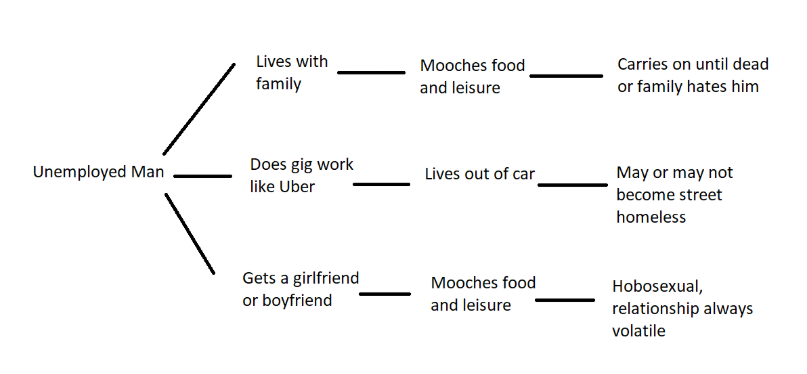
Also more than your annual or biannual vacations, you should probably be taking one to two extra days off per month. Working 35-40 hours a week is plainly a lot on your body. I do not mean to insult other professions, but the strain is extra for the valet, as full time work means running about two and half marathons per week, on average. Mileage will vary based on location, but you get what I mean: it’s a lot of work on your body. I advise requesting one extra day off in a row with your other usual days off to create a three day weekend for you. Perhaps strategize these requests at just the right frequency that your boss doesn’t notice exactly what you’re doing.
As for what you’re doing with your time off…I’m going to be so bold as to state that if you’re struggling with this, for one thing, you and I would get along, and for another, you’re in a very bad way. The internet is fond of telling repentant incels and the sort of men who struggle socially that they ought to pick up hobbies. I do not know why, precisely, this word “hobby” and this advice seems practically offensive to me. It has never worked for me. I have tried these hobbies out of unnatural desire to rid myself of a boring personality: tennis, bird-watching, snowboarding, beach-going, the gym, photography, a wide array of sexual fetish community participation, church attendance, collecting retro video games, typewriters, and antiquarian books, cooking, motorcycle riding, ping-pong, bowling with and without a league, billiards much the same way as bowling—though in dark and wonderful bars, I feel I could increase the list ad infinitum with silly adventures and pursuits.
It is the manner in which I approached all of these functions that is fundamentally scary: I was trying them in the hope that they’d change my life. Often I’d try something in the hope it would attract others to my life, because I was lonely. There is nothing wrong or offensive about having hobbies, please, understand that I believe that. But you should only do a thing because you want to do a thing. That’s why, if you’re on the internet asking strangers how to better yourself, you’re in a very bad way, probably worse than you realize.
The fast way to mend this brokenness of time and spirit is instead of getting a hobby, do something of service. Create something for others, or help them quite basically with their needs. Do something that is not for you at all. Do things for others. In this mode of behavior, even when you can’t produce the right spirit of genuine, earnest giving, the consequence for everyone else is still positive, like an atheist donating to charity. It doesn’t matter to the charity receiver if the atheist believes all of humanity is pointless, dumb, and wishes for our speedy extinction.
Because I know that at least one person reading this might mutter the stupid excuse: “I have nothing to offer others.” That’s baloney. There are only a handful of human needs. Less than ten, as far as I can tell, though I’m no anthropologist. If you have nothing else, you can always give someone else your attention. It’s amazing how often someone in this world feels that nobody is giving them enough attention. I cringe and seethe when I see coworkers dealing with an angry customer, and the dopey valet says something like “this isn’t as big a deal as you’re making it.” Nine times out of ten the angry person, indeed, is behaving out of proportion. But the appropriate thing to do with a stressed out human on a valet driveway is give them your full attention. Eye contact. Open ears.
To sum up, I have to ask myself, how can I advise anyone to keep their life together off the tables? Off the job? It’s too broad a notion, and I can’t possibly know what your life is like. And my own life has been a hurricane. But I know that good times happen, and then bad times, and then good again, and then…well that sort of cycle happens for everyone. Someone once said that comedy is tragedy plus time. It’s bizarre how optimistic this phrase is. For if you try to renegotiate the values, the equation always remains an expression that given long enough, doves and a wedding await. I’m still working towards that kind of brilliant expectation, but for now, I can say that gratitude gets me along day to day.