Chapter 26: Literary Theory
There is a character type in literature known as the “superfluous man.” Like his title suggests, the superfluous man is essentially unnecessary to his time and place, he’s extra, a person that does not fit a functional niche in his society. The novel-in-verse Eugene Onegin is often considered the first example of the superfluous man, painting the portrait as an educated dandy, a wealthy man disaffected with aristocratic traditions, and subsequent books, also often from 19th and early 20th century Russia, tend to picture this unnecessary character as affluent, womanizing, gambling, drinking and all around rabble rousing. In the case of the OG superfluous man, these activities really don’t excite him much at all. He feels hollow, save for brief fits of passion—even the love interest of the novel, a woman named Tatyana, wonders if Eugene has any personality at all, or if he just has the face of one. And since I know my valet readers are likely to at most just google the book I’m talking about and never read it—you’ll see images of a duel occurring in the results. You’d think a duel would rustle the jimmies of any man, but when Onegin ultra reluctantly agrees to pick up the pistol, the feeling he experiences most acutely is annoyance. The excitement or dread, or alternatively a basic aversion to dueling is instead overruled by a tedious boredom: Onegin agrees to duel like a four eyed ginger child might agree to play little league. It’s not his thing. But everybody’s doing it.
Where the superfluous man of 19th century literature was decidedly wealthy, an elbow rubber of the kind I see booking thousand dollar rooms day to day at my work, I propose to you that the superfluous man of present day is basically poor, but has achieved, through a diaspora of vice and banality, all the same habits of the wealthy nihilist. Gambling, drug taking, womanizing—these things don’t take much money or passion at all to pursue in this century. There’s an app for each one of them, and enough human bodies bumbling around the cities of this world that colliding with them is always inevitable. The towering comfort and complacency afforded by general American life is circled by a vast network of creditors. Modern usurers have it well calculated that the young and restless are some of their best customers. Most of the guys I work with are so young that one heartbreak might derail their next decade. They don’t vote. They don’t cook. They haven’t caught the boomerang of repeat miseries in their soft hands. And yet, with an income of thirty five thousand a year and 86 dollars in the checking account, J.P. Morgan trusts them on the finger with fifteen thousand credit. They finance Subarus for five years, put a spoiler on it, and void the warranty with an exhaust that sets off car alarms.1
-
A small bit of my experience: say I started work at a new valet location tomorrow, if you told me to walk around the garage and pick out which cars were owned by employees and which cars were hotel guests’, I could easily discern the difference. If you specified “which cars are owned by our valet staff?” I could probably guess with 80-90 percent accuracy. And if you showed me pictures of the valet staff and asked me to match each person to their car, I’d probably be about 60-80 percent accurate.
Where the old and new superfluous men differ is time. Onegin and the aristocrats didn’t know labor any more than today’s crypto trading bro. They were wayward dandies, perfumed to the teeth and free from the clock. For the new man without purpose or meaningful place, he vacations from a life of existential dread by punching a wage job and surrendering his time to a service or occupation he doesn’t respect or even understand. Neither the old nor the new superfluous man has a vocation, ultimately. There is not a linear path for them to walk towards eternity. The milestones of accumulation, property ownership, procreation, retirement and eulogy are piecemeal at best, or else completely unavailable. Well, I suppose the eulogy is always available.
The sloth or free-wheeling aristocrat was as grotesque in his time as the valet is in ours—which is not to say too detestable, on the surface. But at the Napoleon zeitgeist balls of 1804, as well as at the two bedroom apartment valet vape-and-reefer party of 2024, these men without vocation are always expected to free themselves from their own carelessness. Party guests are so bold in their gossip about the superfluous men that they chide within earshot of him about the waste of talent in the room. Women who fall in love with these cads almost invariably picture them as a future success, as potential, and alternatively enjoy partnering with a victim of ambiguous, complex personal turmoil.
It is hard to have pity on the superfluous man, old or new. Their suffering looks so much self-imposed. Worse yet, criticisms of the literary variety are too often in the clouds. While I’m mounting an argument now about lowly wage earners being the new “superfluous man,” I could easily swing my criticism towards the high-minded academics who invent such terms. But this book is not about the high minded in high places.
It may be about the high minded in low places. It’s my dubious belief that there are lot of you. My hope is that this text offers you some relief from your tremendous disinterest in life, whether that’s dueling or parking cars. My idea is quite old. It is not to sell you a formula for material advancement, but rather, one that equips you to live with what you’ve got. Before getting too wildly off the topic, I’ll repeat that my job is, on its face, a very antiquated, and a basically silly profession. When something in life is so obviously dumb, there are two reactions to choose from: laughter and anger. It’s possible to do both, of course, but whenever you can, choose the former. Laughter is the devil retreating.
Of the bitterness I myself often suffer, I sometimes think that my talents are not being used properly. The feeling can be pinpoint, pertaining to small detail, or grand, like the superfluous man and all the dopey social connotations it has. This is another type of useless negativity. You’ve got to work wherever you’re at. Still, this grumbling about my assignments crops up. If my boss schedules me for a bellman shift, invariably I think it is a waste of my valet talents, and how much better everyone would be if I were parking cars. And that’s when I can pause and see the humor. Because I can just as well find myself thinking I’m too good for parking cars. That my genius is wasted on such a profession.
In one of the more recent psych ward stays I was gifted, the main room was lined with recliners and sedate nutjobs like myself. On the walls, tacky, third grade style posters stated base reminders for healthy living: “Take a shower,” or “brush your teeth,” “take your meds!” with little stars and smiley faces underlaying the text. I recall screaming at one of the orderlies, at one point, “I’m a master of literature, goddamnit!”
One of the other inpatients laughed. I hope that helped her. It helped me. In due reverence for the full complexity for literary genius, I must scatter some discouraging seed by saying that the superfluous man is overwhelmed with talent and ability. His dilemma is as much feeling dull internally as it is feeling useless externally—the grand feeling of being useless. There are really very few new ideas. Maybe there just plain aren’t any. The idea of the “superfluous man” came about in the nineteenth century, but a man out of work feeling shitty goes back to the cavemen who fails a hunt. The odd thing that has happened, I propose, is that nowadays jobs are so odd, specific, and repetitive that most men even working an average job feel shitty about it. And look, it gives me no pleasure to pen a masculine critique or popular sentiment about males, but so we’re clear, the same subject in regards to women is a totally different arena, with overlap of course in a Venn-diagram of occupational hazards, but when I’m talking about men in this chapter, as well as most of this book, I do mean men.
Chapter 27: Picking Your Spot
So you’re a car parking employee. You greet the guest, write the ticket, and get the keys. The owner of the car in front of you walks inside the building without fanfare, tip, or much of an impression in your mind. You’re both just two NPC’s detached from life’s main storyline. The quest is elsewhere. Princess is not in this castle. Nothing tremendous happened, and now it’s time to park the car.
You take it into the garage. It is neither a busy nor a dull day, just average. There’s under a hundred cars in the garage, and it’s about 4:30pm, before the dinner rush. When it’s slow like this, park cars in the far away spaces, because there’s no stress in returning to the driveway quickly.
There is a definite and fine logic to the actual space you put the car in as well. Take, for instance, this crude diagram of available parking spots:
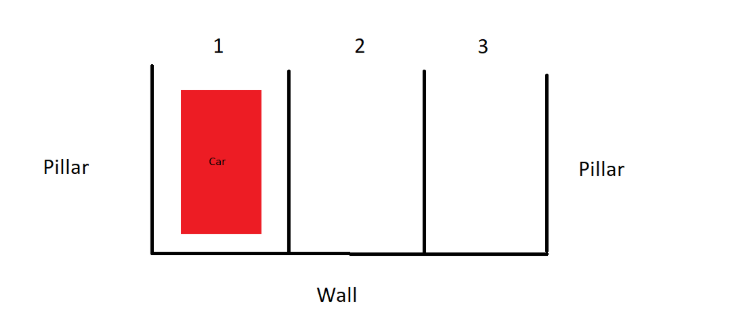
Note that in the many different garages I’ve worked, this is standard architecture (three parking spaces between pillars). There are outstanding exceptions and parking structures with extreme quirk, but the above example is illustrative of a general spaceology. Pop quiz: Assuming no crazy or errant variables, if you approached spaces 1, 2, and 3 intending to park in one of them, which space should you put the car in?
Is it easy? It should be easy, right? Spot 1 is occupied already. That leaves only two options. I assume that my dimwit coworkers who select the wrong answer here defend themselves by arguing that it really doesn’t matter. And I suppose I’m a little bit crazy to note that their opinion on this matter might be emblematic of the divide between a bad valet and a good one.
The correct answer is spot 3. There are multiple reasons, but the primary one is that leaving the middle space open accomplishes two things at once:
If no other car ever gets parked in spot 2, cars in spot 1 and 3 and have a safer and smoother departure from their respective positions later.
It is easier for spot 2 to be parked in finally. Middle spots are almost always cushier in terms of actual room between cars, and there is a somewhat easier time parking in them psychologically than corner spots which I can’t finely explain, nor is it much worth scientifically explaining.
Note that if all the proposed spaces were available, the worst thing you could do is park a vehicle in spot 2. Doing so would make every next available option to future cars the most difficult and hazardous.
Another way to think about it: it’s more of less just like selecting a urinal.
I’m not sure that what I’m about to say can really be taught or learned, though I’ll say it anyway: the overall guiding factor in what space you choose is consideration for others. You should be leaving cars in a way that makes other people’s lives easier. True, you might be the next person to park a car anyway, and you don’t feel any particular need to work with consideration for others, but generally, the assumption is that you’re constructing a collaborative. Of the many imaginations people have of Heaven and Hell, I’d bet the former is a place where people are parking in spot 3, and the latter is a place where people are parking their cars on the middle of lines to intentionally protect their own vehicle.
Chapter 27 and a Half: More About Selfishness
Another thing very noticeable working a job as small as mine: people seldom fix other people’s mistakes. What I’m referring to can be ridiculously small. For instance, if I’m walking through the garage and drop a piece of trash, the odds of another employee picking it up are incredibly slim. It will almost invariably require that I circle back a second time, notice the trash, and pick it up, despite several dozen others noticing the trash as they went along the same route.
Mistakes of this fashion can escalate to errors of greater severity. Do not shrug off this callousness of psychology as a minor peeve. Say a car in the garage has the lights left on. I have witnessed whole crews of valet attendants bicker on the driveway about who left the lights on, when obviously it matters very little who did it. Go and turn the lights off so the car doesn’t die.
This selfishness can be weaponized in a direct fashion as well, often in extremely gross examples. One time a guest came down to ask why his bags hadn’t been delivered to the room in over an hour, and the valet who was responding said “oh John’s the bellman. He should be on that.” Might as well proclaim to the man that we’re a tribe of highly classified chimpanzees. (I hope it’s plain that the correct response to the man would be “I’m going to get that for you right now.”)
I could rattle off hundreds if not thousands of these examples. The point I really wish to hammer home is that you will be an absolutely divine worker if you stop viewing the job as a place where you take control of your responsibilities and manage them well. Instead, view the job as an effort to bring harmony to the mass chaos that is all around you. Beware, however, that some personalities have a habit of trying to bring order to what is already in harmony. This is another kind of evil. Have you ever worked a retail job where, when there were no customers, the boss had you do something hilarious like scrub the vents on the ceiling? “If you’re leaning you could be cleaning!” Oh my god. It makes me want to kill myself again whenever someone says that maxim. No. Sometimes there’s nothing to clean. Some jobs do have dull moments.
That said, it’s this habit of most worker’s—their habit of only minding their own business, combined with the general wage workers complete inability to clock in and out on time—it’s this habit that makes it very easy to be the “best” valet at your location. If you fix other people’s mistakes, if you do things like empty the trash, if you wipe bird shit off a guest’s windshield, you’ll be in the one percent of glorious, top-tier valets. I swear to you most of my peers have their minds so froze over with fear that they would see the bird shit on the windshield and think something crazy like “I didn’t shit on it/maybe they don’t want it cleaned off?”
Finally, I generally don’t want to make excuses for anybody, but frankly I don’t have a hard time forgiving my coworkers who display a whole lot of this selfishness. And God would frown at me if I didn’t confess that I’ve been as selfish as anyone at various timestamps in my career, as well as even more deplorably in my personal life. Some consider suicide the most monstrous sort of selfishness. I’m not too afraid to say it is, either, on account of the dead can’t be offended, so far as I know. Forgive me if it’s too campy to say this—but I don’t have a hard time forgiving a suicide, as much as I don’t have a hard time forgiving my coworkers for their selfish habits.
However, there is something about the act of picking up another person’s mistake that is a perfect gesture of forgiveness. Maybe forgiveness isn’t rated that highly anymore. Maybe empathy isn’t either. We just heard too much about them for too long. Or maybe everybody is perfect nowadays. I don’t know. But that’s the thing about a suicide. It’s certainly harder to forgive them, because you can’t pick up their mistake. I want to, in the worst way. I want to walk in to my friend’s San Francisco apartment the day that his heart stopped. I want to pick him up off the floor and hold him so that even if he still dies, even if I can’t bring him back with panicked cries for help at least he won’t have to be alone in the last moments.
There are some mistakes that can’t be forgiven. Not by the average man, anyway. Take pleasure in the little ones you can. I must emphasize: it’s a joy to be able to fix a mistake, whether it’s yours, another’s, or everyone’s or nobody’s.
Chapter 28: Non-Disclosure
Because this book is an alternation between work and my unsuccessful suicide, I think it’s pertinent to state directly that I have never disclosed my death attempt with anyone from my work life. The closest I’ve ever come to doing so was sharing the title of this book with a co-worker somewhat recently (and none of its content), and frankly I regretted even airing that much, or admitting that I was authoring this thing.
Like I stated in a previous chapter discussing work/life boundaries, it’s my recommendation that you almost never share outstanding health information with your employer. Of course, because of the nature of my action, I was out of work for a considerable period after the attempt, and that sort of gap is somewhat noticeable. Even before that, I had shaky mental fortitude, such that I missed big chunks of employment, sometimes months at a time, due to serious and dangerous moods in the years leading up to it.
Plainly I do not think anyone who has ever interviewed me for one of these jobs has had enough intelligence to put together the pieces of my mental health struggles via résumé. Alternatively, wage jobs are so full of incredibly traumatized, abused, delinquent, all-around-life-fucked individuals that I’m actually a fairly standard hire, even if they know I’m a moody merry-go-round of personal life disorders.
For those of you who are reading this book more on the half of suiciders than you are valet, firstly, I hope you’re doing well, and secondly, I also don’t think you should disclose any diagnoses you have, nor your traumatic past with very many people in your personal life, as well as having a hard line never with employers. The good thing about it, either way, is that you have liberty when to share whatever you want to share, assuming what you suffer from isn’t apparent on your body, or through repetitive social interaction.
To disclaim some of my motive: I get a little irked by public drives towards “mental health awareness.” They’re beginning to spread this notion with some vigor in my country. And maybe it’s due. Maybe, in fact, my gender, who is disproportionately over-achieving in both suicide and homicide, desperately needs a peachy ultra-liberal therapist to blow some incense at them. I suppose what I advise is that you be mentally aware, sure. But awareness doesn’t make a sound. It’s just a state of being.
I am willing to share a little bit further on this topic of mental health, just briefly, because if you carry a burden like a psychiatric disorder, there are two main problems associated with it:
The disorder
People’s perception of your disorder
I can’t help you with you the first problem.
The internet has made this second problem so pervasive that you really must not utter anything easily Googled to someone. If you ask the internet about my life, it may recommend basically avoiding me, and certainly never getting involved with me in a serious relationship.
a) A mood disorder
b) A suicide attempt
c) Drug and alcohol addictions
d) Gambling addiction
e) Throw in a couple STD’s just for shameful good measure
I qualify for many support groups, and have indeed attended many. Some support groups I can vouch are places of extreme love and tolerance. Others are little more than where freaks get together to find vulnerable or mutually infected sex partners. I can tell you from these social experiences, assuredly, that organized “mental health awareness” has the same reductive oversight that all identity groups political or social suffer from, though perhaps even worse than most of those. That is to say, only a silly person believes LGBTQ persons all monolithically agree with one another and seek the same agenda, or that all people of a given ethnicity unanimously look out for one another’s interests, as if they are all interested in precisely the same goals. And the same is doubly true of any alleged “mental health community,” for each patient of the community has been stamped with a precise (though doctors know it’s quite imprecise) label, and each of these labels carries its own social status. They are not all equal.
An advantage, I suppose, of not disclosing whatever diagnosis you may have with others, is that you will at times catch them talking about what you suffer from, without them knowing you suffer from it. It makes life like a little play—like you’re an actor in God’s scene of irony. One time I had a coworker, from another department, utter a damnation about something that I am diagnosed with. She said plainly “I fucking hate ____ people” while talking to someone else, and though I had missed the context, I remember hearing that part quite well and feeling a terrible sense of shame. I never told her I had what she was referring to.
When she quit the job some months later, she hugged me, and she told me I was her favorite coworker. She didn’t hug anybody else, was never a particularly chatty employee, and I took the gesture as fairly monumental, though it would be a little disappointing if she was simply attracted to me in the male-female sex way (never anything between us in that way, so I have my hopes it wasn’t). During the hug I thought of that moment in the break room. I could tell her, right then, while our bodies are squished together. It’d be so delightful. Gotcha! I’m _____!
But no. That would be devious and self-serving. That’s another hard part of these things. If you’re like me, talking about things is how you work through them. But most of the time, you can’t. Not to worry. Everyone on the planet is like that really. No person is completely understood by anyone else. It’s just impossible. I used to stress a good deal about people not understanding me. And in a fit of victimhood, one time I expressed this to the most intelligent friend I had—probably the person most capable of understanding me—I had said to him almost like he was excluded from my condemnation of humanity…”nobody understands me,” slight teenaged California accent to my delivery, whiny, but nonetheless sincere. He burst into laughter. At the time I was maybe 27, 28 years old. He was coming up on 70. After gathering himself after the laughter, he matter-of-factly stated that no, nobody will ever understand me. He was fully on board with that tragedy. But he could easily see that my practical response was plainly idiotic. If nobody will ever understand you, the decision to grow bitter about others is the most selfish route you can take. Make like St. Francis, he said.
It’s impossible to know how unduly self-conscious or paranoid I’m being when I say that I often feel my peers, my patrons, and my bosses make an unjust assumption that I’m a sort of dumb person, presumably because the station of my work is lowly. In tactical rhetoric, it’s almost always an advantage to be underestimated in this way, though I’ve not been mature enough in the past decade to relax and utilize this perception, and I’ve made many arrogant mistakes trying to demonstrate my genius to others along the way. The silly, young, and masculine structure of valet companies, fortunately, allows me to breathe a little, and see the operation as humorous. As I get older, I find myself frequently amused, without sarcasm, at the confederacy of dunces running things around me. The things which used to chip away at my will to live, and I must note that resentment and bitterness—though they don’t feel like a fast death, truly are—these things more and more often seem plainly humorous to me. This is a critical divergence in what some call “self-care,” or others may refer to as “mental health,” or “managing stress,” or even more nebulous terms such as “worldview” or “spirituality” (forgive me, I’m Californian). I can positively assert that descent into an unmanageable spirit is the mental path where life’s absurdities, injustices, and chaos weigh on your mind as unsolvable filth. But you are equally capable of viewing the same chaos with levity and gratitude. I am guilty of forgetting the lowest moments of my life quite frequently, but undoubtedly my current station as a valet employee, low and silly as it might be in my culture, is nowhere near the depravity I’ve parked in previously. I do not regret trying to end my life, though of course I do not recommend it. I sometimes feel sorry for my old self as if he were another person completely. Is that a type of regret? I don’t know. But grief brings glory. If you live.